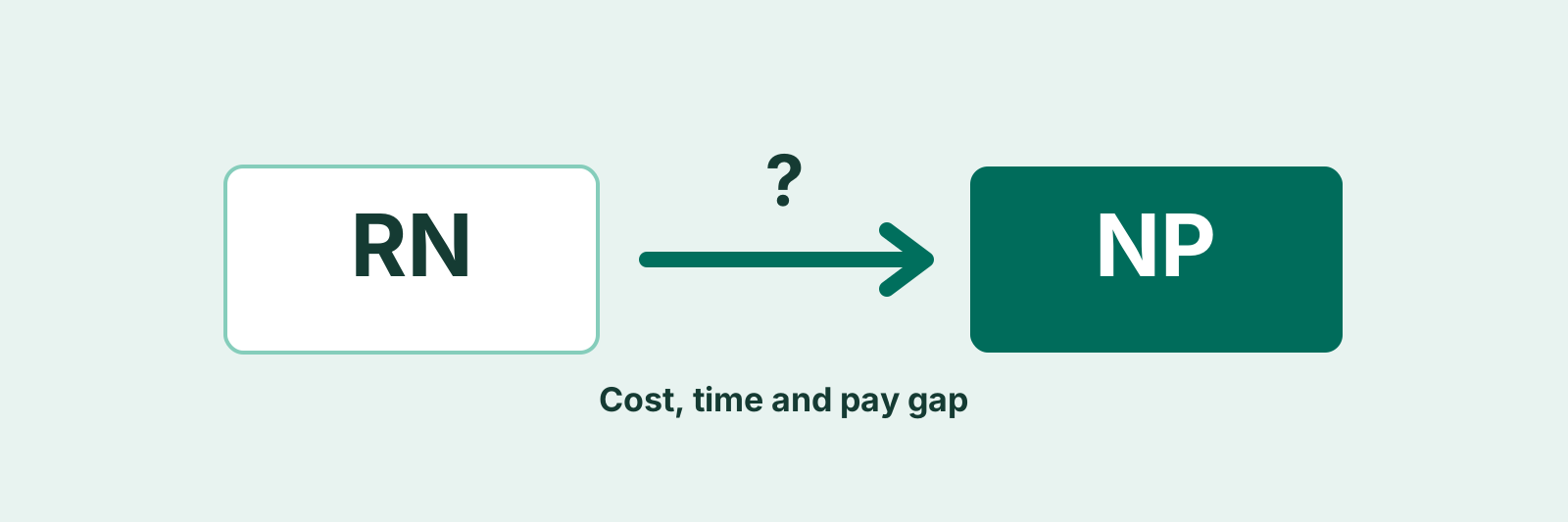
For RNs who are deciding whether NP school is worth the time and money, and RNs already in a program
Is NP School Worth It? How RN and NP Pay Compare
Compare RN and NP pay, the costs of NP school and the income you give up while studying, with official BLS figures for May 2025 and a calculator for your own numbers.
NP school is worth it when three things are true: the NP role fits the patients you want to care for, you can pay for the program without a debt load that outlasts the pay gain, and you expect to stay in an NP role long enough to recover the time and money you put in. The national pay gap is real. Median NP pay in May 2025 was $132,300, compared with $97,550 for RNs. Whether that gap pays off for you depends on your costs, your loan terms and the years you spend studying.
The Short Answer
For most RNs, the answer depends on four numbers: total program cost, the RN income you give up while you study, the interest and term on any loan, and the NP pay you can realistically expect. If the NP pay gap is large compared with your total cost, NP school is more likely to pay off. If the cost is high and the gap is small, or you would leave NP work soon after certifying, it is less likely to. Test your own figures with the Is NP School Worth It? calculator before you decide.
Who This Question Is For
This guide is for two kinds of reader. The first is an RN who is still deciding whether an NP role is the right next step. The second is an RN who has already started a program and wants to know whether to keep going, change tracks or change how they pay for it.
Staying an RN can be the right answer. So can a different route, such as a bachelor’s or a specialty role that does not need an NP credential. The goal here is to make the numbers visible, not to push you toward one answer.
What the Pay Gap Looks Like
The Bureau of Labor Statistics (BLS) publishes the figures most people use to compare RN and NP pay. The table shows national medians and percentile ranges for May 2025.
| Measure | RN | NP | Source |
|---|---|---|---|
| Median annual pay, May 2025 | $97,550 | $132,300 | BLS Occupational Outlook Handbook (RN and NP) |
| 10th percentile annual pay, May 2025 | $68,940 | $101,340 | BLS (RN: Occupational Outlook Handbook; NP: OEWS national estimates) |
| 90th percentile annual pay, May 2025 | $137,470 | $174,420 | BLS (RN: Occupational Outlook Handbook; NP: OEWS national estimates) |
| Projected job growth, 2025 to 2035 | 6% | 41% | BLS Occupational Outlook Handbook |
At the medians, the gap is $34,750 a year before tax: $132,300 minus $97,550. That is about 36% more than the RN median. It is a national average across states, employers and years of experience, so your own figure may be higher or lower.
The growth figures describe projected demand, not a guarantee of openings where you live. Read them as one input among several.
The Costs to Count
Most people start with tuition, and tuition matters. It is not the whole cost. Count everything you will pay or give up between now and the first year you work as an NP.
- Tuition and fees for the full program, from the school’s current published schedule
- Books, software, uniforms and clinical equipment
- Travel, parking and housing for clinical placements that are far from home
- Required background checks, immunizations and health screenings
- The certification exam fee and the state licensing fee
- Any loan fees, origination costs and the interest you will pay on borrowed money
Program costs are set by each school, so compare the program’s own published figures. Do not use an average from a website. If a school does not publish a total, ask for one in writing before you count on it.
The Income You Give Up
The cost that surprises many students is the RN income they stop earning. Some students keep working part-time, others cut their hours, and some stop working for part of the program. Each choice changes the math.
When you run the calculator, enter the RN income you expect to keep during school, not your full-time pay. A small change in that share can move the break-even year more than a small change in tuition.
What Loan Terms Change
If you borrow part of the cost, the interest rate and the repayment term decide how much you pay in total. A longer term lowers the monthly payment but usually increases the total interest. A higher rate increases both. The calculator shows the monthly payment, the total interest and the year your gain catches up to your cost, so you can compare terms side by side.
I am an AGACNP student. Loans and repayment are the part I wish I had understood before I started. Check the loan terms you are offered before you accept them, and write down the monthly payment you expect to make after school.
How to Test Your Own Numbers
The calculator on the tool page takes your numbers and shows the result. Nothing you enter is sent to RNtoNP or stored. Use it this way:
- Enter your current RN pay and hours, and the share you expect to keep during school.
- Enter the total tuition and fees for one program you are considering, and the number of school years.
- Enter the share you expect to borrow, the interest rate and the repayment term from your loan offer.
- Enter the NP pay you expect in your area and the hours you plan to work.
- Compare the break-even year and the total difference over the years you set. Change one input at a time to see which one matters most.
Keep a record of each scenario. The companion worksheet has a log for this, and a printable checklist of questions to ask each program.
Common Misconceptions
- “The median is what I will earn as a new NP.” The median is the middle of all NPs in the survey, across states, settings and experience. New graduates and people in some settings may earn less, and some may earn more.
- “Tuition is the whole cost.” Tuition is usually the largest visible cost, but lost RN income, clinical costs and loan interest can add up to more.
- “If I borrow, the monthly payment is the cost.” The monthly payment shows you what you pay each month. The total interest and the length of the term show what the loan costs over time.
When NP School May Not Be Worth It
NP school is less likely to pay off in these situations:
- The total cost is high, and the NP pay you expect is close to your current RN pay.
- You would leave NP work soon after certifying, or you do not plan to practice as an NP.
- The population or setting you want does not match an NP role. Use the NP paths by population to check the fit.
- You need the income during school and cannot cut your hours without a hardship.
Each of these can be a reason to wait, choose a lower-cost program, or stay in your current role while you decide.
Frequently Asked Questions
Is the pay gap the only thing to count?
No. The pay gap is one input. Total cost, the income you give up during school, loan terms, time to finish and whether the role fits your patients all change the answer.
Do the national figures apply to my state?
Not directly. The BLS figures are national. Check the figures for your state and the setting you plan to work in, and use them in the calculator.
What if I stop before I finish the program?
Money you have already paid, and any loan you have already taken, still count. Ask the school for its withdrawal and refund rules in writing before you enroll, and plan for the case where you need to stop.
Can I compare programs with different lengths?
Yes, if you use the same inputs for each. Enter each program’s total tuition and fees, its number of school years and your expected hours, and compare the break-even year and total difference side by side.
Check the Program and the State Before You Count On It
The pay figures assume you finish a program that prepares you for a recognized NP role and that you can practice in your state. Two checks matter most:
- Accreditation. Check that the program, and the track you plan to enter, is on the list published by the Commission on Collegiate Nursing Education (CCNE) or the Accreditation Commission for Education in Nursing (ACEN). Check the accreditor’s list, not only the school’s website.
- State practice rules. NP practice scope varies by state. The AANP state practice information describes full, reduced and restricted practice. A program in one state does not decide your scope in another, so check the state where you plan to work.
The Preparing to Apply to NP School guide has a step-by-step check. For the role and population choice, see How to Choose an NP Pathway and RN vs. NP.
Next Step
Run your numbers for one program in the calculator this week. Then write down the three inputs you are least sure of, such as the loan rate, your NP hours or the cost of clinical travel, and find the official source for each.
Key Takeaway
Free download
NP School Cost Checklist
A printable checklist of the costs and income to count before you decide whether NP school is worth it, with space for your own figures and sources.
- Every cost to count, from tuition to income you give up while studying
- A place to record each figure, its source and the date you checked it
- The questions to ask a program about total cost before you enroll
Sources & further reading
- U.S. Bureau of Labor Statistics: Registered Nurses (Occupational Outlook Handbook)
- U.S. Bureau of Labor Statistics: Nurse Anesthetists, Nurse Midwives, and Nurse Practitioners (Occupational Outlook Handbook)
- U.S. Bureau of Labor Statistics: Occupational Employment and Wage Statistics (OEWS)
- National Council of State Boards of Nursing (NCSBN): APRN Consensus Model
- American Association of Colleges of Nursing (AACN) / Commission on Collegiate Nursing Education (CCNE): CCNE Accreditation
- Accreditation Commission for Education in Nursing: Accreditation Commission for Education in Nursing (ACEN)
- American Association of Nurse Practitioners (AANP): Nurse Practitioner State Practice Environment
Official requirements can change. Verify details with the relevant school, certifier, or nursing board before acting.